Martin Schlögl
|
Apr 22, 2026
|11 min read


For a long time, managed hosting has been the most practical way to run web applications. Why? Because infrastructure is complex, and operating secure, highly available environments requires constant monitoring, patching, scaling, and operational expertise. A managed hosting provider handles that heavy lifting, so your team can focus on building applications rather than maintaining infrastructure.
For many organizations, this model still works well. But the way companies use the cloud is changing.
Many now operate mature cloud environments with established networking policies, security tooling, and governance frameworks. They have centralized logging, standardized identity and access controls, and long-term spending commitments with hyperscalers like AWS, Google Cloud, and Azure. If all these pieces are already in place, it raises a natural question:
Shouldn’t your application be hosted in the cloud account you already manage?
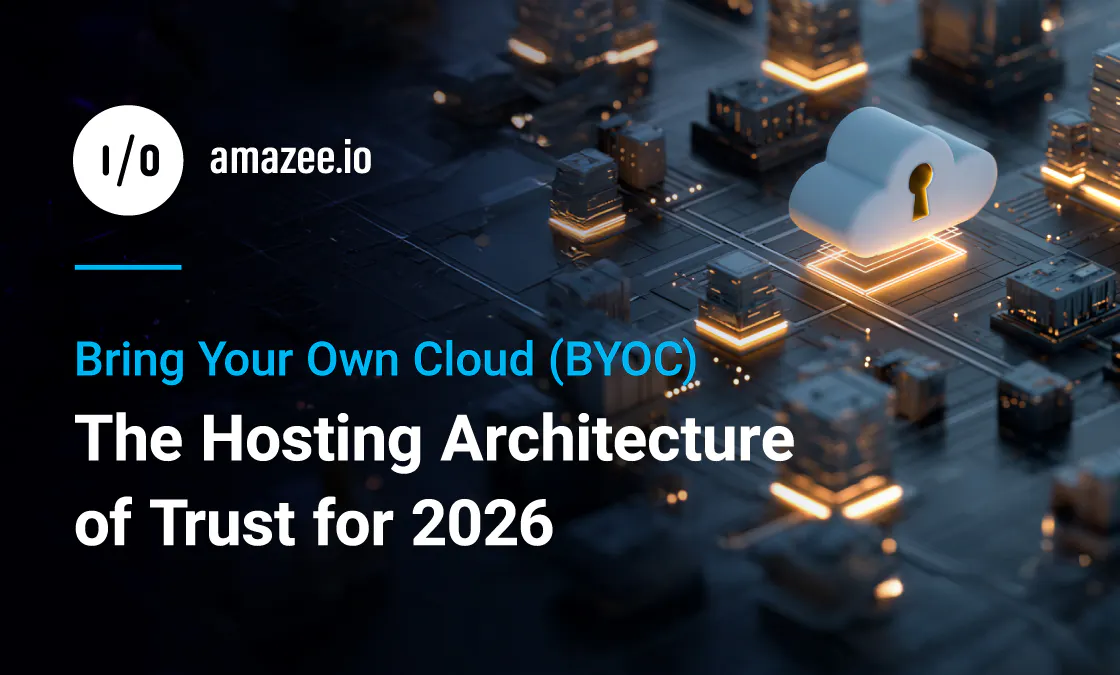
This is where Bring Your Own Cloud (BYOC) comes in.
At amazee.io, BYOC is best understood as a deployment model of our managed hosting platform. You get the same fully managed operations and platform expertise, but the infrastructure runs in your own environment instead of ours. This fits our broader “run anywhere” approach: whether your workloads live in your organization’s AWS/GCP/Azure account, on your own physical on-premises servers, in a highly isolated Dedicated Cloud environment, or in another approved infrastructure footprint, the goal stays the same. In the modern enterprise, your infrastructure account is your premises.
In a BYOC architecture, the platform provider still manages the operational layer. Deployments, environment provisioning, scaling logic, monitoring, incident response, and routine platform maintenance remain fully managed. The difference is where the underlying infrastructure lives. Compute, storage, and networking resources are provisioned inside your cloud boundary, so your team retains native visibility and auditability through the tools you already trust.
For technical teams, this turns hosting from a “black box” into a “glass box.” You get the operational simplicity of a managed platform, while keeping infrastructure ownership, governance, and observability anchored inside your own environment.
The idea behind BYOC is simple, but making it work well depends on a clean split between operational control and infrastructure ownership. In traditional managed hosting, both the platform and the infrastructure live in the provider’s environment. With BYOC, the infrastructure is moved into your cloud account, while the platform provider continues to run the operational layer.
Technically, this is usually done by separating the management plane from the data plane.
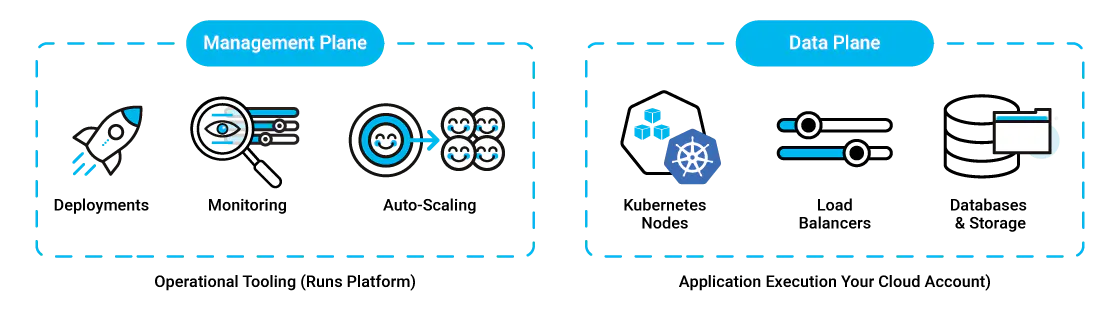
That separation lets the platform operate like a managed service, while you maintain ownership of the resource. In many deployments, you start with a clean, dedicated Kubernetes cluster that is isolated from other workloads. This improves performance predictability, simplifies networking, and keeps security boundaries clear.
With a typical managed hosting provider, the internal IT department often has very little say. Web hosting is outsourced, creating a shadow IT scenario in which applications live outside the company's core governance and security frameworks.
BYOC completely changes this dynamic, making it more attractive to IT teams. Because the underlying infrastructure (like AWS, GCP, Azure, or on-premises servers) is typically provisioned, owned, and governed by the IT department, website hosting is brought back under their control. Developers still get the agile, managed platform they need, but IT remains involved. They maintain oversight of the network, enforce corporate security policies, and monitor resources through their own centralized tools.
Most BYOC deployments do not place workloads directly into a primary corporate cloud account. Instead, they use a dedicated sub-account or subscription that acts as a controlled sandbox for the managed platform environment.
In AWS, for example, this often means a child account with its own networking, compute, and storage configuration, while still connected to organization-wide governance. This significantly reduces the “blast radius.” If something goes wrong in a staging environment, it stays in that sandbox rather than spilling over into sensitive areas like finance or corporate identity. You get separation where you want it, and visibility where you need it.
A common procurement question is whether BYOC provides enough isolation compared to a purely on‑premises setup. These days, strong logical isolation can be as robust and auditable as physical separation. The key difference is not whether hardware is shared. It is who controls the boundaries around your workloads and data.
Think of the cloud as a high-security apartment building. Everyone shares the foundation, but only you have the keys to your unit (your VPC). amazee.io acts like the building manager: keeping operations running, but only entering the areas you explicitly permit. Even on shared hardware, your application can still operate as if it were in a private, hardened vault.
In a BYOC model, security and uptime are not owned by one party. They are shared across a stack, with each layer managed by the party best equipped to handle it. Getting clarity here early helps procurement because it turns the question of who is accountable into an actionable map of duties and escalation paths.
Responsibility typically breaks into three layers:
Your hyperscaler of choice (or your internal IT for on-premises) secures and operates the underlying cloud: data centers, physical hardware, and the core virtualization and network backbone.
We run the platform layer: Kubernetes operations, monitoring, incident response, scaling logic, and routine platform upkeep. Where application-level maintenance is included in the service scope, we also help coordinate and apply routine updates in collaboration with your team’s release process.
You control the infrastructure account boundary: root credentials, internal policies (including data classification), and who in your organization can access systems or approve changes.
For example, if there is a hardware incident, AWS replaces the affected hardware. If platform-level updates are required, amazee.io applies them as part of managed operations. Your team manages user access roles so only approved people can request changes or access sensitive data.
A major procurement advantage of BYOC is that it reduces the risk of becoming a “data hostage” because the infrastructure is yours.
If the management contract ends, you still retain the cloud account, the data, and the infrastructure assets because they were never in the provider’s account to begin with.
BYOC gives you ownership without making you run day-to-day ops yourself.
amazee.io focuses on keeping the platform healthy: OS patching, Kubernetes upgrades, monitoring, and preventing resource issues from turning into incidents. Your engineering team focuses on shipping value through application code.
In practice, we keep the underlying platform current and stable in the background, while your team deploys feature changes on top.
BYOC procurement often hits one big friction point: why does a third-party provider need elevated permissions at all? It feels like a paradox. On one hand, security teams want strict guardrails and total control. On the other hand, “self-healing” infrastructure requires the platform to act like an automated administrator. A mature BYOC model is built to balance both.
The simplest way to see the trade-off is operational. In a manual ticket model, a crashed node triggers an alert, a human requests access, waits for approval, and then starts recovery. It is controlled, but slow. In an automated self-healing model, the platform can take a narrow set of pre-approved actions immediately, so recovery happens in seconds, not hours.
To deliver fault-tolerant hosting, the platform must be able to provision and reconfigure infrastructure in real time, without waiting for approvals during an incident.
Picture a 2:00 AM node failure. The platform detects the problem, provisions replacement capacity, and updates routing to avoid traffic to the unhealthy component. Users may never notice. Without elevated permissions, recovery becomes reactive and delayed, increasing the risk of downtime.
👉 Dive Deeper into Fault-Tolerant Enterprise Hosting
We solve this “paradox” by keeping permissions strictly within a sandbox and following the principle of least privilege.
In practice, amazee.io does not need access to your whole organization. Access is limited strictly to the dedicated environment used for the platform (such as a dedicated sub-account or subscription). Permissions are granted via defined IAM roles that allow necessary operational actions while blocking sensitive identity operations. Access is typically short-lived and role-based rather than relying on long-lived shared keys, and you can revoke that trust immediately if needed.
BYOC also changes the trust model. In SaaS, you often rely on the provider’s assurances. In BYOC, actions happen inside your infrastructure boundary, so you have the logs. Management activity can be recorded in your native audit tools (e.g., AWS CloudTrail or Azure Activity Log) and then forwarded to your SIEM. During an audit, your security team can pull a timeline of what changed, when it changed, and which role performed the action, without having to ask a vendor for evidence.
This glass-box visibility turns operational access into a governed, reviewable control. Furthermore, because our platform is open source, there are no hidden black-box mechanics. amazee.io also holds ISO27001 and SOC 2 Type II certifications. When you combine an open-source, certified platform with a deployment that runs entirely within your already-trusted environment, onboarding and IT auditing processes become drastically faster and easier.
BYOC moves the focus from simple “vendor costs” toward overall efficiency. Your infrastructure becomes an asset you can optimize within the financial agreements you already have, while still receiving white-glove managed operations.
For example, if you have a $1M AWS EDP (or an Azure MACC commitment), BYOC lets you run production hosting in your own account so that infrastructure spend counts toward burning down that commitment, while amazee.io provides the managed layer.
Most large enterprises already have committed spend and credits. With BYOC, you can apply those directly to real production hosting because the infrastructure is billed through your account. That means you benefit from the discounts you have already negotiated, rather than paying “retail” rates hidden inside bundled SaaS pricing.
Procurement often cares as much about the process as it does about the price. BYOC gives you options to match however your team prefers to work.
BYOC is also a glass box financially. Your infrastructure costs are native to your cloud account, so you can see exactly what is running and what it costs, without hidden hosting margins. The management fee becomes easier to assess as an operations layer rather than a blended markup.
The result is a healthier rhythm: your team can work with our engineers to right-size resources and remove unused capacity, while keeping the operational burden off your internal teams.
Beyond the operational and financial benefits, the value of BYOC also lies in its preparation for the next wave of technology, specifically the shift toward (agentic) AI.
As AI becomes more ubiquitous, the key question is no longer “where is my website?” It is “Where is my data being processed by AI?” Agentic AI systems do not just generate text. They take actions, query internal systems, and make decisions based on proprietary context. That is why traditional vendor-hosted SaaS can feel risky for regulated or data-sensitive organizations. BYOC lets you use AI while keeping your most sensitive data inside your security boundary.
For example, a healthcare organization may not be able to send patient records to a public LLM endpoint as raw context. In BYOC, you can deploy an agentic bot that analyzes the data while compute, data stores, and context remain within your own VPC. The agent can still produce useful outputs, but the underlying dataset remains protected.
Agents are only as good as their context: internal docs, tickets, customer records, and product data. The security gap in many AI “add-ons” is that context retrieval pulls data out to an external service.
With BYOC, Model Context Protocol (MCP) becomes a practical control point. You can host MCP context servers inside your own cloud environment, close to the systems they connect to. The agent can fetch what it needs locally, apply your access controls, and keep sensitive context inside your perimeter.
👉 Gain Expert Insights into Agentic AI and MCP
Your proprietary data is not just a compliance concern. It is a competitive advantage. BYOC supports a zero-trust posture with AI providers, as governance remains anchored in your cloud account.
Sensitive context stays in your environment, access is observable through your audit logs and security tooling, and you can control what an agent is allowed to touch. You also reduce long-term lock-in: as models improve, you can update the AI layer without migrating your underlying data to a new vendor ecosystem.
BYOC is not just a hosting decision. It is an AI-readiness decision. Agentic systems work best when they sit next to the data they need, with low latency, strong governance, and predictable operations. BYOC provides a foundation for AI to scale without creating new compliance gaps.
By bringing your own cloud, you are not only securing today’s web presence but also preparing for tomorrow's. You are creating a private, governed environment where the next generation of AI automation can operate safely.
Retain total ownership of your AWS, GCP, or Azure resources while offloading the operational burden to our team. It’s the managed platform you need, inside the cloud account you already own.
From meeting strict compliance requirements to building the foundation for Agentic AI, BYOC is the architecture that allows your team to scale with confidence.
👓 [Article] Why Fully Managed Secured Data Hosting is Your Best Defense Against Security Risks
👓 [Article] DDoS Attack Mitigation for Enterprises
👓 [Webinar] Continuous Software Security with Dependency-Track