Nicole Laine
|
Sep 01, 2026
|8 min read


Before getting into the meat of this article, we need to get something important straightened out. There are three terms that are increasingly being conflated: data residency, data localization, and data sovereignty. These terms are connected, certainly, but they are not the same thing, and understanding this is crucial to developing your sovereignty strategy.
Firstly, we have data residency. And this relates to the physical location of data.
An organization might choose a specific region for data storage because of performance, procurement requirements, customer expectations, or internal policy. For example, a European enterprise may decide that its application data should be stored in Frankfurt, Zurich, or London.
While this is an important decision, it’s only one part of the sovereignty picture. Residency does not automatically tell you who operates the platform, who has administrative access, where backups are stored, or which legal obligations apply to the provider.
In other words, data residency is necessary for many sovereignty strategies, but it is not the same thing as sovereignty.
Data localization is a stricter requirement. It means certain types of data must remain within a specific country or jurisdiction for legal reasons.
This typically applies to data in regulated industries, such as health data, financial data, education records, and other sensitive categories. In these cases, moving data across borders may be prohibited or subject to strict safeguards.
For global enterprises, localization can create operational complexity. You may need to run services in different countries or regions. And this is where architecture becomes important. If your platform is tightly bound to a single proprietary provider, meeting different local requirements can be slow, expensive, or technically difficult.
Data sovereignty is broader than residency or localization. It relates to whose laws, controls, and access rights apply to the data.
That includes the physical location of data, but it also includes:
This is the crucial part that many organizations can miss. A workload can be hosted in Europe, while still being operated by a provider subject to non-European legal obligations. For some organizations, this might be acceptable. For others, especially those in regulated sectors or public-sector supply chains, it may not be.
| Feature | Data Residency | Data Localization | Data Sovereignty |
|---|---|---|---|
| Core Focus | Physical server location | National geographic borders | Legal authority and control |
| Main Driver | Speed, cost, and company choice | Government laws and mandates | Legal risk and data privacy |
| Rule Type | Optional internal preference | Mandatory law for specific data | Mandatory framework for full legal safety |
| Key Question | Where do the servers sit? | Must the data stay in-country? | Which court system controls the data? |
| Parent Company Risk | Ignored | Partially covered | Fully evaluated (includes foreign parent laws) |
One of the biggest misconceptions in cloud strategy is that a local data center automatically means adherence to local laws and regulations. It is easy to see why this happens. A provider offers an EU or UK region. The contract says the data will be stored there. On paper, it all looks good.
But for strict sovereignty requirements, the data center's physical address is only one aspect to consider. The ownership and legal structure of the provider also matter. So do administrative access, support operations, subcontractors, monitoring tools, backup locations, and disaster recovery processes.
The US CLOUD Act often comes up in sovereignty discussions because it can allow US authorities to request data from US-incorporated technology companies, including data stored outside the United States. This doesn’t mean you have to avoid every US-headquartered provider. But you do need to understand the exposure and make a deliberate risk decision.
Infrastructure within a European region may satisfy a data residency requirement, but might not satisfy stricter sovereignty requirements if the provider, parent company, or support model creates additional access routes.
Some questions to ask when deciding where to host your data:
European regulation is moving toward more scrutiny of resilience, third-party risk, operational control, and responsible data use.
Frameworks such as the EU Data Act, NIS2, DORA, and the EU AI Act are not identical, but they point in the same direction: organizations need to evidence how their digital operations are controlled.
Vendor review needs to go beyond examining which region is being used for data storage. It should include parent company, jurisdiction, subcontractors, support model, administrative access, backup locations, telemetry tools, encryption key management, and AI integrations.
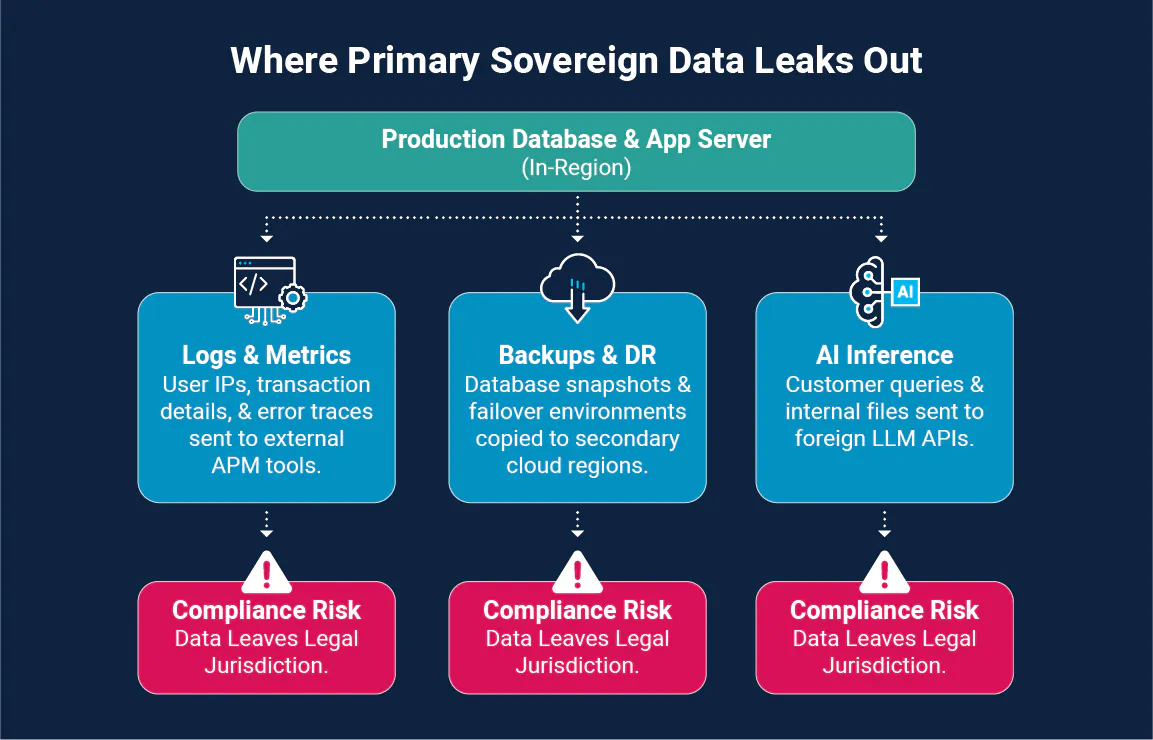
When considering data sovereignty, the primary focus is often on the main database, but this unfortunately ignores many other points where data could cross to another region or jurisdiction.
Modern platforms generate logs, alerts, analytics, backups, CDN activity, and AI interactions. It is important to be aware that data can move through these supporting systems even when the main application is hosted in a chosen region.
Application logs, web server logs, error traces, monitoring, and analytics events may contain more sensitive information than you might expect, like IP addresses, user identifiers, URLs, search terms, transaction details, and some personal data. If this data is sent to a monitoring platform in another jurisdiction, the organization may inadvertently create a cross-border data flow.
For enterprise Drupal and web platforms, this is especially relevant. A website can be hosted in the correct region while operational data is sent elsewhere for logging, analytics, error tracking, or support.
Backups can be another common blind spot. While a production database may be stored in a specific region, snapshots, archives, disaster recovery, staging, or development environments may be stored elsewhere.
Disaster recovery is essential, but the issue is whether backups are mapped, governed, retained appropriately, and aligned with the same sovereignty requirements as production.
Executives should know where backups are stored, who can restore them, how long they are retained, and whether secondary regions meet the organization’s obligations.
The increasing ubiquity of AI has led to newer, often less visible data flows.
If prompts, documents, customer queries, or internal content are sent to third-party AI APIs, this could introduce sovereignty and compliance risks. Even if the main platform is hosted regionally, AI inference calls can pass sensitive information through external systems.
As organizations embed AI into websites, support journeys, search experiences, internal tools, and content operations, they should know where prompts are processed, whether data is retained and can be used for training, where logs are stored, and who can access that history.
For some organizations, the answer may involve secure private AI gateways, zero-data-retention configurations, or infrastructure choices that keep AI workloads under tighter regional control.
A sovereign cloud is a cloud setup designed so that data, operations, access, and governance remain within the boundaries required by an organization or jurisdiction.
That will not look the same for every company. For some, it might mean working with a local cloud provider. For others, it could mean a dedicated environment, a customer-controlled account, regional infrastructure, or tighter rules around who can access systems and when.
What’s important is knowing and being able to prove where data is stored, who operates the platform, who can access it, how keys are managed, and how backups are handled.
→ Dive Deeper: The Best Open Source Cloud Providers in 2026
Decoupling the application layer from the underlying infrastructure is one of the most practical ways to strengthen sovereignty.
Open source, containerized application delivery makes this possible. When applications use open standards, Kubernetes-native operations, and portable tooling, they are less dependent on one proprietary cloud provider. That gives companies more options. Workloads can run across local, regional, dedicated, or customer-controlled infrastructure without forcing teams to rebuild each time requirements change.
This is where amazee.io comes in. We provide managed open source hosting built around our open source application delivery platform for modern web applications. We help teams build, deploy, and operate applications consistently, while keeping the platform portable across different infrastructure environments.
For business leaders, the value is strategic. Portability reduces lock-in. Open source increases transparency. Infrastructure choice gives the organization more ways to meet sovereignty, compliance, and customer requirements.
Encryption is important, but it cannot carry a sovereignty strategy on its own.
If the same provider hosts the infrastructure and controls the key management system, your organization may have less independence than expected. For sensitive enterprise platforms, you need to know who controls encryption keys, who can rotate them, who can access them during an incident, and whether key management depends on the same provider hosting the data.
This is another reason to look beyond location and assess control across the whole platform.
You do not need to become an infrastructure engineer to get a handle on data sovereignty. But you do need to ask better questions and make sure the right controls are in place.
Start by reviewing your hosting, cloud, monitoring, backup, analytics, CDN, and AI providers.
Look at ultimate parent companies, legal jurisdictions, subcontractors, support models, and administrative access rights. The aim is not to rule out every provider with international operations. It is to understand the risk properly, rather than relying on region selection alone.
Assess how portable your platform really is.
If your architecture depends heavily on proprietary cloud services, understand what it would take to move. If moving would require a major rebuild, that is a business risk, and open source application delivery, containerized workloads, and Kubernetes-native operations can reduce that risk by making the application layer more portable.
For enterprises running Drupal, web, or application platforms, this can be the difference between being locked into a single provider and adapting as sovereignty requirements change.
Map more than the production database, but include logs, telemetry, backups, disaster recovery, staging environments, support access, error tracking, search indexes, analytics, CDN services, and AI integrations.
This often reveals data flows that were not visible at the time of the original hosting decision. Once they are visible, they can be governed.
Choose partners that support your sovereignty posture rather than forcing every workload into one cloud model. Managed open source hosting can help enterprises combine operational support with infrastructure choice. In other words, expert operations without giving up flexibility and control.
amazee.io supports this approach by helping enterprises run critical Drupal, web, and application platforms on open source, Kubernetes-native foundations, with portability and infrastructure choice built into the model.
Want to understand whether your hosting setup supports your sovereignty requirements? Talk to our team.
👓 [Article] Why Fully Managed Secured Data Hosting is Your Best Defense Against Security Risks
👓 [Article] ISO/IEC 27001 Certified Managed Hosting Excellence
👓 [Case Study] Enhanced Security, Zero Downtime: Modernizing Sandoz's Global Drupal Hosting Platform
Nicole M. Laine is a Digital Marketing and Advertising Specialist at amazee.io and amazee.ai, bringing more than 14 years of high-performance online marketing and search strategy experience to the team. Holding a Master of Arts in Media Communication from the University of Zurich, Nicole has a distinguished track record of leading complex digital campaigns, including tenures as Head of Online Marketing at Amazee Metrics (now Advance Metrics) and as Senior Specialist, International SEA, at Webrepublic. At amazee.ai, she operates at the crucial intersection of technical discovery and market execution, collaborating directly with core software development and AI engineering teams to translate low-level technical infrastructure into highly discoverable, clear, and on-brand enterprise content. She specializes in leveraging data analytics and search engine behavior to transparently communicate complex cloud hosting, data privacy, and secure AI gateway frameworks.